Why I Built InDive — Indonesia’s Dive Directory
journal · mar 2026InDive started as a plan to improve the SEO on my other website.
That’s the honest version. I wasn’t trying to build a product. I was looking at Ocean Earth Travels and thinking: if I want to rank better for Indonesian diving content, I should have more detailed information about the destinations — dive site descriptions, marine life, conditions. The kind of content that’s actually useful and not just a sales page.
So I started looking at what data existed. I started pulling things together. And fairly quickly I hit a problem: if you want to do this properly for Indonesia, you’re not writing a few pages. You’re documenting hundreds of dive sites across 17,000 islands. That’s not a section of a travel agency website. That’s something else entirely.
The thing that kept nagging at me was how bad the existing options are.
If you use the PADI app or the SSI app, there’s a dive site database in there. But it’s locked inside a proprietary system, the data is often inaccurate, and it only covers sites that are logged by users — which means the remote, genuinely interesting places are blank. If you search Google for dive sites in a specific area of Indonesia, you’ll find a few dive center websites with inconsistent information, maybe a blog post from 2017, nothing structured.
For a country that contains more marine biodiversity than anywhere else on the planet, the information infrastructure is surprisingly bad. I’ve been diving Indonesia for years and I still regularly arrive somewhere with limited advance knowledge of what’s actually there.
I wanted to fix that. Not in a startup-pitch way — just in a “this thing should exist and it doesn’t, so let me see if I can build it” way.
The first version came together in about three to four weeks. I used Claude Code to speed up the development, which made it possible to build something genuinely functional as a side project alongside running OET. The data came from a mix of sources: publicly available information, Google data, my own knowledge of the sites, and input from partner operators across the archipelago.
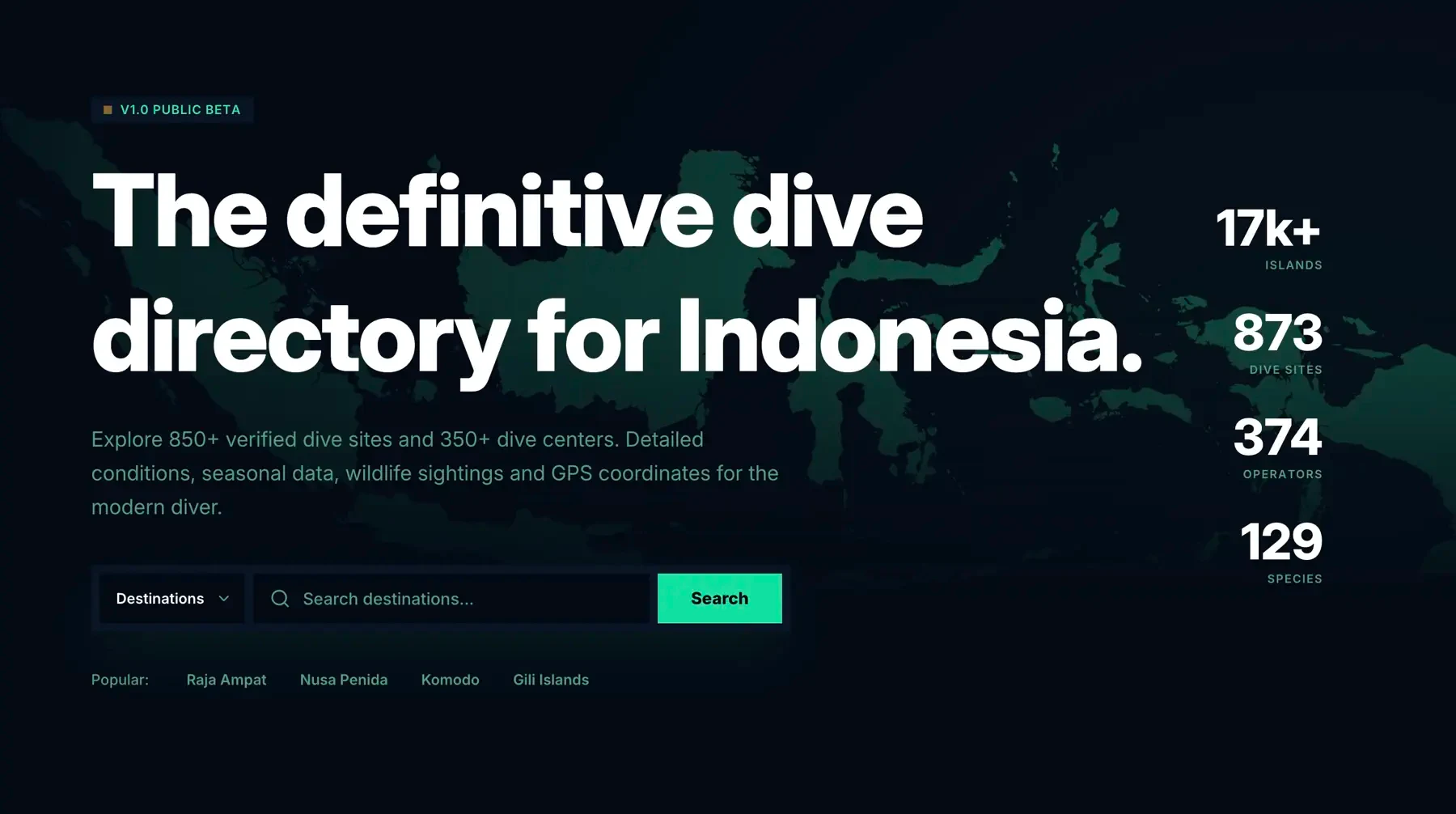
That last part is still the work. The site is live at indive.io — it’s in soft beta, no big announcement yet — but what I’m focused on now is accuracy. I’m working through our network of dive operators and specialists, destination by destination, to verify the data and fill in the gaps. The idea is that before this gets a proper public launch, the people who know Alor best have reviewed the Alor sites. The people who dive Cenderawasih Bay every week have confirmed what’s there.
It’s slower than just publishing and hoping for the best. But a directory where divers can trust the information is only useful if the information is actually trustworthy.
The moment it became obvious that InDive needed its own brand was when I realised how much content could exist here — and that it shouldn’t live on OET. Ocean Earth Travels is a curated, concierge-style operation. We go deep on the specific trips we do, not on everything. InDive is something different: a directory for diving fans who want to explore, research, and plan on their own terms. The two serve different people in different modes. Trying to be both on one website doesn’t work.
I have no growth targets for InDive, no investor expectations, no pressure to monetize quickly. If it becomes something that dive centers want to be featured on, if trips get booked through it, great. But the original motivation was simpler than that.
There was information that divers needed and couldn’t easily find. I had the background — digital, diving, years in this specific part of the world — to try and build something better. So I did.
It’s at indive.io. Still a work in progress. Feedback welcome.